What to Expect During an EMDR Intensive: A Guide for Greenville & Simpsonville Residents
The Bottom Line: Key Clinical Takeaways
Accelerated Memory Reconsolidation: An EMDR intensive condenses months of traditional trauma therapy into immersive, multi-hour clinical sessions over 1 to 3 consecutive days, eliminating weekly session delays.
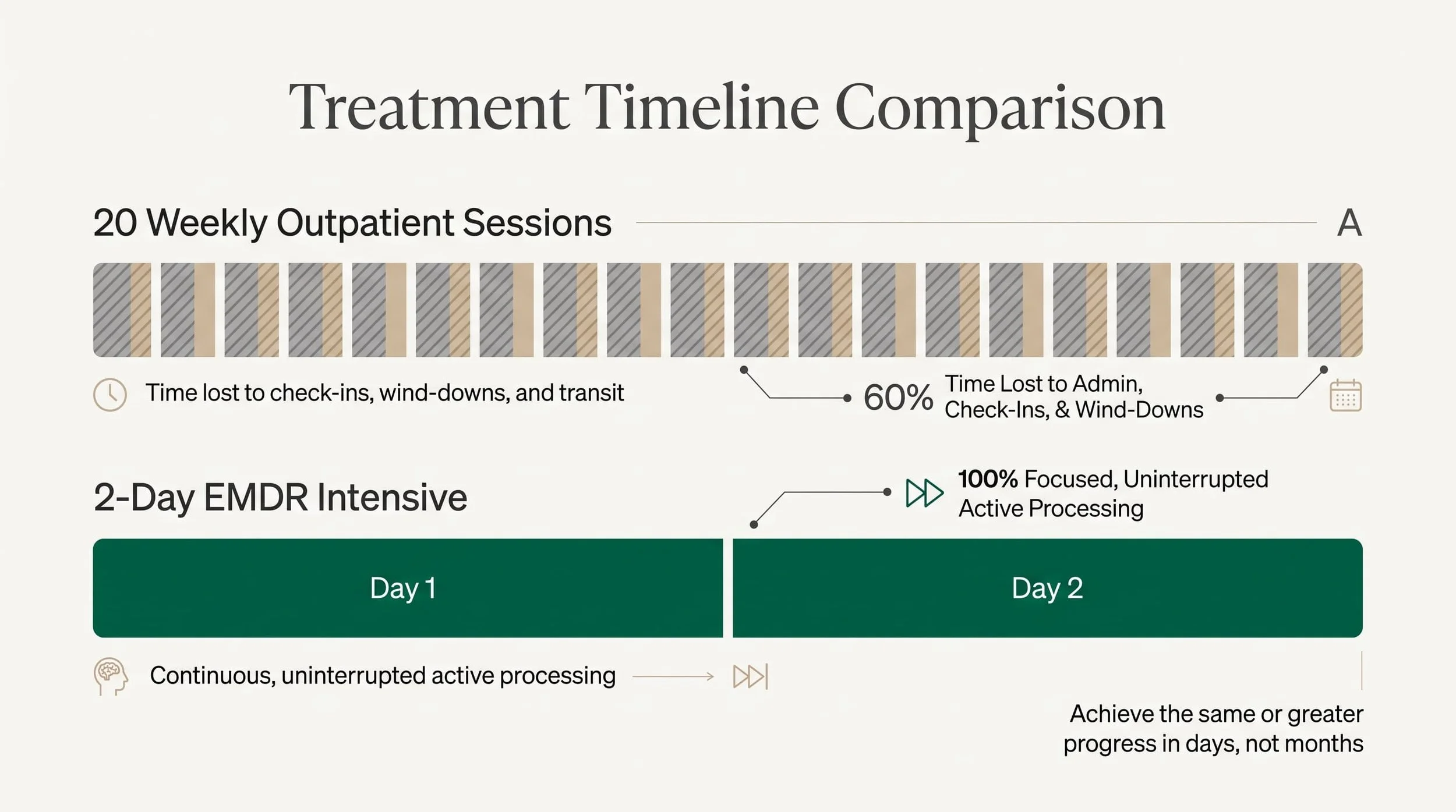
Maximizing Active Processing Time: Eliminates the ~60% session startup and wind-down overhead typical of 50-minute outpatient visits, dedicating 10.5+ uninterrupted hours to active Phase 3–8 EMDR processing.
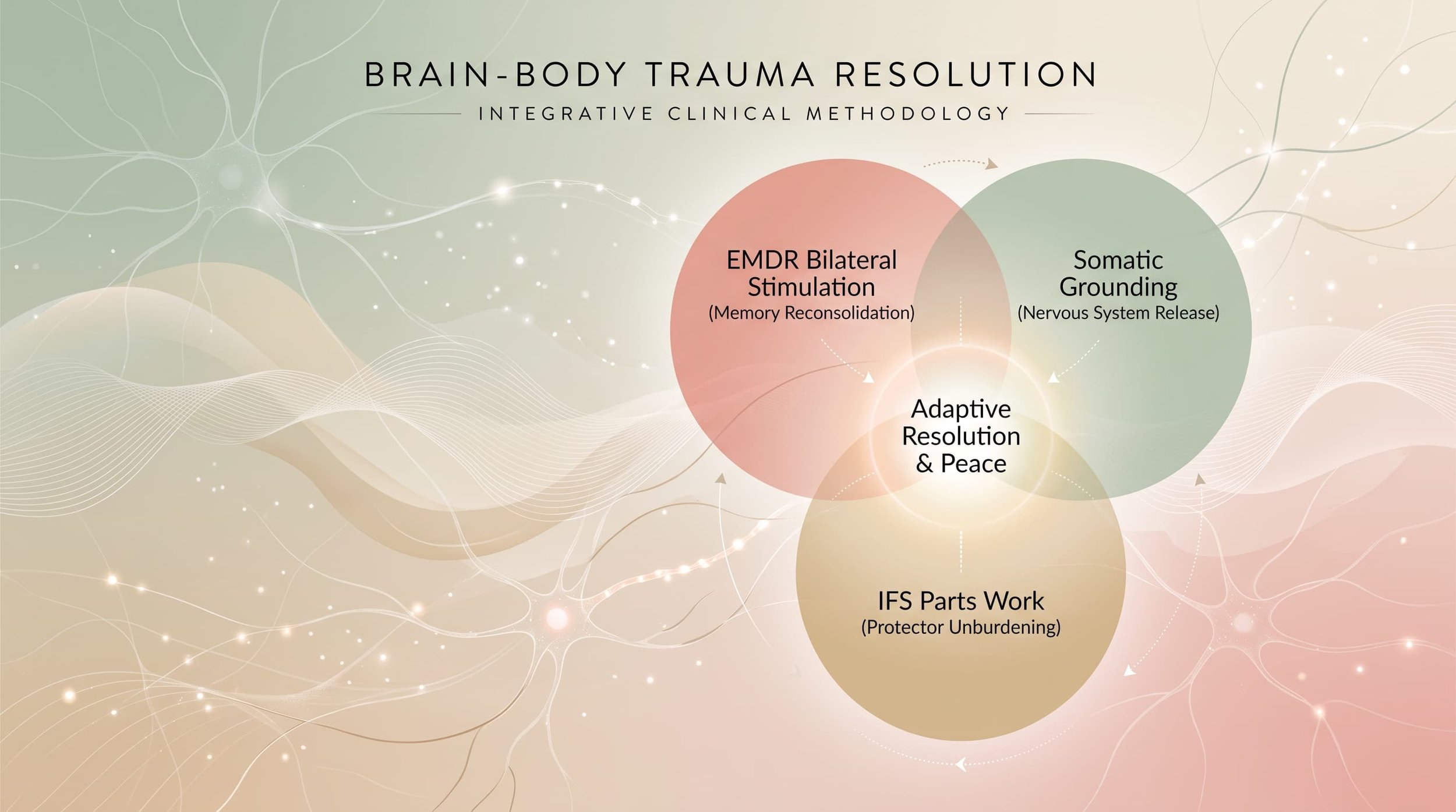
Integrative Neuro-Somatic Care: Merges EMDRIA-aligned bilateral stimulation with Somatic Experiencing and Internal Family Systems (IFS) parts work to discharge trauma stored within the physical body and nervous system.
Executive Privacy & Autonomy: Offered under a confidential private-pay structure that protects clients from mandatory psychiatric diagnoses on permanent medical records, with Superbill provision for potential out-of-network reimbursement.
If you have spent months or even years in traditional talk therapy, you might recognize a very specific kind of emotional exhaustion.
You arrive at your weekly session, spend the first fifteen minutes catching your therapist up on your week, spend twenty minutes touching the edges of painful memories, and then spend the final fifteen minutes trying to pull yourself together so you can walk back out to your car and navigate the traffic on I-385 or Woodruff Road.
Week after week, the cycle repeats. You understand your trauma intellectually, yet your nervous system remains on high alert. You feel the physical weight of unresolved stress in your chest, your shoulders, and your stomach.
Healing should not feel like an endless loop.
In my clinical practice at VIVA Mind Therapy in Simpsonville, I work daily with adults, first-generation immigrants, healthcare workers from Prisma Health and Bon Secours, and driven professionals across Greenville County who are ready to move beyond basic survival and step into lasting resolution.
An EMDR intensive is designed specifically to break that start-and-stop cycle—giving your brain and nervous system the uninterrupted time they need to complete the healing process.
What Is an EMDR Intensive?
An EMDR intensive is an accelerated, concentrated format of Eye Movement Desensitization and Reprocessing therapy.
Rather than spreading treatment across six to nine months of 50-minute weekly visits, an intensive condenses your therapeutic work into focused blocks of 3 to 6 hours per day over 1 to 3 consecutive days.
How Concentrated Trauma Processing Accelerates Healing
The human brain possesses an innate capacity to heal from psychological wounds, much like the physical body repairs a cut. In clinical terms, this is guided by the Adaptive Information Processing (AIP) model.
When a traumatic or distressing event occurs, high levels of stress hormones can prevent the brain from filing the memory away correctly. The memory remains "frozen" in its raw, state-specific form—complete with original sights, physical sensations, and distressing beliefs like "I am not safe" or "I am not enough."
EMDR utilizes bilateral stimulation (BLS)—alternating side-to-side eye movements, auditory tones, or gentle tactile pulsers—to activate both hemispheres of the brain. This rhythmic stimulation unlocks the frozen nervous system response, allowing the brain to reprocess the traumatic material and store it as a neutral past event.
When processing occurs in an intensive format, the brain enters an optimal state of neuroplasticity. We are not forced to stop just as your nervous system begins to release the trauma. We stay with the memory until the emotional distress drops to zero and an adaptive, empowering belief is fully locked in.
Why Traditional 50-Minute Therapy Can Delay Recovery
While many believe weekly therapy is the gold standard for mental health, our clinical experience shows that standard 50-minute outpatient sessions were designed around insurance billing codes, not the natural rhythm of human neurobiology.
When you only have 50 minutes:
Session startup overhead: The first 10 to 15 minutes are inevitably consumed by administrative check-ins, updates on weekly stressors, and transitioning into the therapeutic space.
Truncated processing: The therapist can safely allow only 20 to 25 minutes of active memory reprocessing before they must pause.
Premature containment: The final 10 to 15 minutes must be dedicated to closing down the trauma container and grounding your nervous system so you can safely drive home.
For complex post-traumatic stress or deep attachment wounds, this constant opening and closing of emotional wounds can leave you feeling destabilized between sessions. An intensive removes the startup and shutdown tax entirely.
Curious whether your nervous system is suited for an accelerated format? You can explore our clinical consultation process to discuss your unique timeline.
Weekly Therapy vs. EMDR Intensives: The Clinical Math
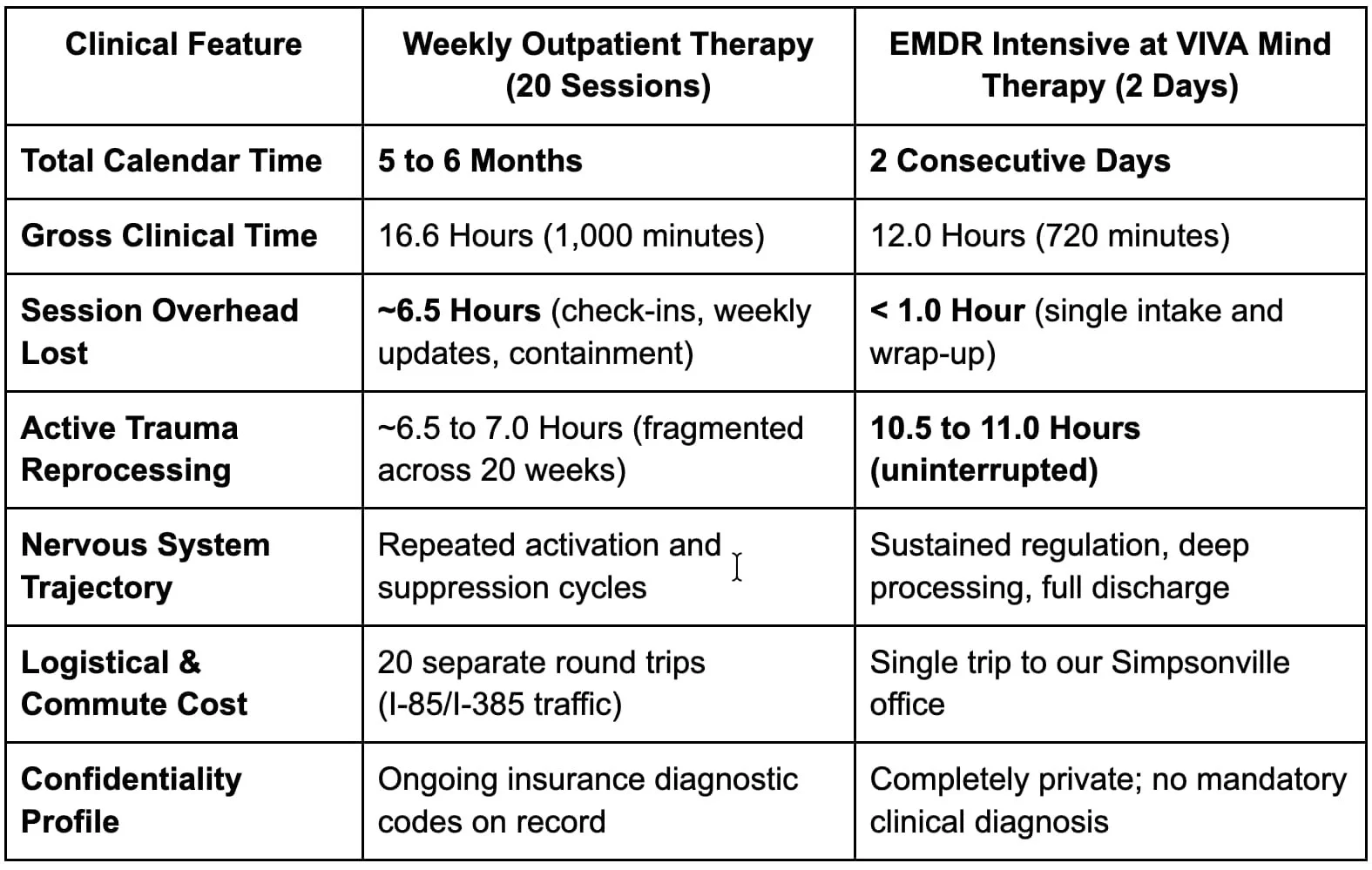
To understand why EMDR intensives achieve results so much faster, it helps to examine the actual clinical hours dedicated to trauma resolution.
When you eliminate weekly therapy overhead, a 2-day intensive delivers nearly double the active processing time of five months of weekly sessions.
How the 8-Phase EMDR Protocol Works in an Intensive Format
EMDR is not a loose or unstructured conversation; it is a standardized, 8-phase psychotherapy protocol backed by the EMDR International Association (EMDRIA) and the World Health Organization (WHO).
In our Simpsonville clinical office, we take these proven phases and structure them into immersive therapeutic arcs that honor your nervous system's capacity.
Phase 1: History-Taking & Target Mapping
Before your intensive begins, we map your traumatic blueprint during a pre-intensive intake. We do not need every granular detail of your past. Instead, we identify the "touchstone events"—the core past experiences that set your current negative beliefs and emotional triggers into motion.
Phase 2: Somatic Preparation & Resourcing
Before we touch painful material, we establish psychological and somatic safety. I ensure you have reliable, body-based coping strategies—including somatic grounding, dual awareness, and internal safe-state anchors. We do not reprocess memories until your nervous system knows how to return to regulation.
Phase 3: Assessment
For each target memory, we isolate four distinct clinical elements:
The visual image that represents the worst part of the event.
The current negative belief you hold about yourself (e.g., "I am powerless").
The desired positive belief (e.g., "I am in control now").
The somatic location—where that distress physically registers in your body.
Phase 4: Desensitization & Bilateral Stimulation
This is the core reprocessing engine. Using sets of bilateral stimulation (visual tracking, specialized alternating audio, or handheld tactile tappers), we allow your brain to follow its natural associative pathways. In an intensive, we can run multiple desensitization channels back-to-back without hitting an artificial 50-minute time stop.
Phase 5: Installation of Positive Cognitions
Once the distress associated with the memory drops to neutral, we strengthen and install your chosen positive belief. We anchor this cognitive shift until it feels completely true on both an intellectual and nervous-system level.
Phase 6: The Body Scan
Trauma lives in the physiology. You will hold both the original event and the positive belief in mind while mentally scanning your physical body from head to toe. If any tightness, tension, or constriction remains in your throat, stomach, or chest, we continue bilateral stimulation until the somatic channel is clear.
Phase 7: Closure
Every intensive day concludes with structured somatic integration. Because we work in extended blocks, we ensure sessions end on complete adaptive resolutions rather than leaving memories partially open. We ground your system thoroughly before you step out the door.
Phase 8: Re-evaluation
At the start of subsequent intensive blocks and during your post-intensive integration session we assess previously targeted memories to confirm that distress levels remain at zero and adaptive responses are firmly established.
READY FOR CLINICAL RESOLUTION?
You do not have to spend another year managing trauma symptoms in weekly increments. Experience rapid, evidence-based healing tailored to your nervous system.
Schedule Your Free 15-Minute Consultation with Stefany Pedroza, LISW-CP
(Private, Confidential, and Tailored to Your Clinical Blueprint)
Beyond Standard EMDR: Integrating Somatic Grounding & Parts Work
Trauma is rarely just a thought problem; it is an autonomic nervous system injury.
At VIVA Mind Therapy, I integrate Somatic Experiencing and Internal Family Systems (IFS) directly into EMDR to resolve trauma at both the physiological and emotional levels.
1. Somatic Awareness: Releasing Trauma from the Body
When traumatic stress overwhelms the body, the nervous system often gets trapped in a persistent sympathetic (fight-or-flight) or dorsal vagal (freeze/shutdown) state.
During our intensive sessions, we pay close attention to the felt sense—the physical sensations that precede conscious thought. By tracking shifts in your breath, muscle tone, and heart rate, we allow your physiology to discharge trapped survival energy safely.
2. Internal Family Systems (IFS): Working with Protective Parts
Trauma often causes the psyche to fragment into protective internal "parts." You might notice a part of you that desperately wants to heal, while another part feels terrified of letting your guard down or experiencing painful emotions.
Rather than fighting resistance, we welcome it. Using IFS-informed parts work, we honor and unburden these internal protectors before initiating bilateral stimulation. This prevents internal backlash, minimizes emotional distress during processing, and ensures that your entire system feels aligned with recovery.
3. Accelerated Resolution Therapy (ART) Protocols
When memories carry overwhelming visual charge, I also incorporate advanced protocols from Accelerated Resolution Therapy.
Using rapid eye movements and voluntary image replacement, we can re-script the distressing emotional imagery of a memory while leaving the factual knowledge of your history intact. You keep the wisdom of your lived experience without carrying ongoing visceral pain.
Who Is an Ideal Candidate for an EMDR Intensive in Upstate SC?
While EMDR intensives are transformative, they are not a universal fit for every situation.
Because the clinical work is concentrated, candidate suitability is something we evaluate carefully during our initial clinical screening to ensure your safety and readiness.
Ideal Candidates for an Intensive Format:
Busy Upstate Professionals & Healthcare Workers: Individuals who cannot take recurring time away from demanding careers for months of weekly appointments.
Individuals "Stuck" in Talk Therapy: Clients who have analyzed their trauma intellectually but still experience acute somatic reactivity and anxiety.
Single-Incident Trauma Survivors: Individuals navigating the aftermath of car accidents along the I-85 or I-385 corridors, workplace incidents, or medical events.
Adults with Complex Childhood Trauma (CPTSD): Individuals seeking an immersive, dedicated environment to address chronic emotional neglect or family boundary wounds.
Parents & Caregivers: Individuals with packed family schedules who prefer to arrange childcare for a single dedicated weekend.
When a Weekly Model Is Clinically Preferable:
Active Chemical Dependency: Individuals currently experiencing unstable substance addiction requiring medical detoxification.
Acute Psychiatric Destabilization: Individuals experiencing unmanaged psychosis or active dissociative disorders requiring preliminary stabilization.
Environmental Instability: Individuals who do not currently have a safe, supportive living environment to return to after processing.
If you are uncertain which category your current symptoms fall into, our 15-minute clinical intake call will help clarify the safest therapeutic path for you.
Navigating Private Pay, Superbills, and Executive Confidentiality
At VIVA Mind Therapy, our EMDR intensives operate entirely on a private-pay model.
This operational structure is an intentional choice that directly protects your clinical care, personal records, and diagnostic privacy.
The "Privacy Shield" of Private-Pay Trauma Care
When mental health treatment is billed through third-party health insurance:
Mandatory Psychiatric Diagnosis: Insurance companies require therapists to assign you a formal psychiatric diagnosis (such as PTSD, Major Depressive Disorder, or Generalized Anxiety Disorder) that becomes part of your permanent medical record.
Loss of Confidentiality: Insurance claims processors have the legal right to audit clinical session notes, treatment plans, and personal progress updates.
Arbitrary Session Limits: Insurance reviewers—not your licensed clinician—dictate how long your sessions can last and how many appointments you are permitted to have.
By operating outside the insurance system, your treatment remains 100% confidential. No permanent psychiatric labels are mandated, no external adjusters access your clinical records, and your care plan is dictated solely by what you need to heal.
Insurance Reimbursement via Superbills
While we do not bill insurance directly, specialized trauma therapy may be eligible for out-of-network benefits depending on your policy.
Upon completion of your intensive, we can provide you with an itemized clinical receipt called a Superbill. You can submit this documentation directly to your private insurer for potential out-of-network reimbursement. Additionally, clients may utilize Health Savings Accounts (HSA), Flexible Spending Accounts (FSA), and CareCredit to fund their intensive care.
What to Expect After Your Intensive: Managing the Somatic Recovery Period
A common misconception about trauma therapy is that once the session concludes, processing instantly stops.
In reality, memory reconsolidation is a biological process that continues for 48 to 72 hours following active bilateral stimulation.
The "Trauma Hangover" Is Normal and Temporary
Just as your physical body feels tired and sore after an intense athletic workout, your brain and central nervous system require time to integrate deep neurological shifts. Following your intensive days, you may experience:
Deep physical fatigue or a natural desire for extended sleep.
Vivid, neutral dreams as your brain reorganizes memory networks.
Heightened emotional openness or quiet introspection.
A profound sense of lightness, mental clarity, and physical ease in your body.
Best Practices for Post-Intensive Integration
To honor your healing process, we strongly recommend preparing your environment ahead of time:
Clear your calendar: Avoid scheduling high-stress corporate meetings, heavy social obligations, or major life decisions immediately following your intensive blocks.
Hydrate and nourish: Neurological processing consumes physical energy. Drink plenty of water and prioritize nutrient-dense meals.
Rest in nature: Take slow walks through local green spaces like Falls Park on the Reedy, Conestee Nature Preserve, or Heritage Park in Simpsonville to allow your nervous system to ground gently.
Attend your scheduled integration session: Every intensive package at VIVA Mind Therapy includes a dedicated follow-up session 1 to 2 weeks post-treatment to check in, assess progress, and ensure your adaptive shifts remain solid.
Frequently Asked Questions About EMDR Intensives in Greenville, SC
How many hours are included in a typical EMDR intensive?
Our intensives typically run in 3-hour half-day blocks or 6-hour full-day blocks across 1 to 3 consecutive days. During our initial consultation, we determine the exact hourly structure best suited to your target memories and treatment goals.
Where do sessions take place?
In-person intensive sessions take place at our private office at 205 Bryce Circle, Suite C, Simpsonville, SC 29681. We are conveniently accessible to residents across Greenville, Mauldin, Simpsonville, and the broader Upstate region. We also provide secure, HIPAA-compliant virtual EMDR intensives for clients residing anywhere in South Carolina or North Carolina.
Do I have to describe every detail of what happened to me?
No, EMDR and ART do not require you to recount every painful detail out loud. Reprocessing happens internally between you and your brain; I guide and monitor the bilateral stimulation while you focus on the internal memory and physical sensations.
Can I do an intensive if I already have a primary weekly therapist?
Yes, an EMDR intensive works exceptionally well as an adjunct treatment. We frequently collaborate with other therapists across Greenville and Spartanburg to help you break through a specific traumatic roadblock before returning to your regular therapist for ongoing maintenance care.
Reclaim Your Life: Start Your Accelerated Healing Journey Today
Trauma convinces your nervous system that the past is still happening right now. It keeps you trapped in hyper-vigilance, emotional exhaustion, and physical strain.
You do not have to spend another year waiting for relief—accelerated, lasting resolution is possible.
At VIVA Mind Therapy, I provide evidence-based, culturally attuned, and accelerated trauma treatment designed to help you process painful memories and reclaim your vitality—quickly, safely, and permanently.
Take the first step toward lasting resolution.
BOOK YOUR FREE 15-MINUTE CLINICAL CONSULTATION
Connect directly with Stefany Pedroza, LISW-CP to discuss your goals and discover if an EMDR Intensive is the right fit for your recovery.
👉 SCHEDULE ONLINE
📍 OFFICE: 205 Bryce Circle, Suite C, Simpsonville, SC 29681
📞 PHONE: (864) 214-5811
🌐 Telehealth Available Throughout South Carolina & North Carolina
About the Author
Stefany Pedroza, LISW-CP, is a bilingual clinical social worker, founder of VIVA Mind Therapy, and an advanced trauma specialist licensed in South Carolina and North Carolina. Holding certifications and advanced training in EMDR, Accelerated Resolution Therapy (ART), and Internal Family Systems (IFS), Stefany brings years of clinical experience rooted in lived bicultural understanding as a first-generation immigrant. Her neuro-affirming and somatic-centered practice is dedicated to helping adults, neurodivergent individuals, and high-achieving professionals move beyond chronic survival mode into deep, permanent resolution. Learn more about Stefany's clinical background on her full bio page.
Medical Disclaimer & Clinical Safety Notice
The information provided in this article is published strictly for educational, informational, and resource purposes and does not constitute formal medical, psychiatric, or psychological advice. Reading this content or contacting VIVA Mind Therapy does not establish a formal therapist-client relationship. If you are experiencing severe psychological distress, trauma triggers, or mental health symptoms, please consult a qualified healthcare provider or licensed mental health professional for an individualized evaluation and treatment plan.
Immediate Crisis Support Resources
If you are experiencing an acute mental health crisis, suicidal thoughts, or require immediate emergency assistance, confidential support is available 24/7/365:
National Suicide & Crisis Lifeline: Call or text 988 (Available nationwide, toll-free, English & Spanish)
Crisis Text Line: Text HOME to 741741 to connect with a crisis counselor via SMS
Emergency Medical Services: Call 911 or visit your nearest hospital emergency department immediately (e.g., Prisma Health Greenville Memorial Hospital or Bon Secours St. Francis Emergency Center)