You have probably spent months, maybe years, sitting in a counseling office explaining your past. You understand your childhood wounds. You can name your triggers on a whiteboard. You know why you feel anxious. Yet the moment something sets you off, your chest seizes, your stomach drops, and your body reacts as if you were right back in the middle of it.
In my practice at VIVA Mind Therapy in Simpsonville, and across our virtual sessions throughout South Carolina, I see this pattern all the time. People arrive mentally exhausted. Over the last several years, our clinic has walked with hundreds of adults across Upstate South Carolina who felt stuck in talk therapy, helping them find physical calm in just a few appointments. Conventional therapy keeps you trapped in your intellect, talking around an issue while your nervous system stays locked in a physical survival loop that words alone cannot reach.
If you are tired of recounting painful memories without feeling any physical relief, pause for a moment. You can Find Relief Without Forced Retelling: Book Your Free 15-Minute Consultation to talk through your goals in an honest, low-pressure setting.
What Is Accelerated Resolution Therapy (ART), and How Does It Work?
Accelerated Resolution Therapy is a directive, body-focused psychotherapy that resets how your nervous system stores painful memories and physical triggers.
Developed in 2008 by Laney Rosenzweig, LMFT, ART pulls together proven elements of Eye Movement Desensitization and Reprocessing (EMDR), Gestalt therapy, Cognitive Behavioral Therapy, and somatic work into a structured protocol. Traditional counseling often spends months exploring stories and histories. ART takes a different route, working straight with the subcortical networks where trauma lives.
During a session, you remain awake and in full control. Nobody hypnotizes you, and you never have to describe the private details of your memories aloud. By pairing smooth, lateral eye movements with guided visualization, ART helps your brain process stuck trauma, clear physical body tension, and settle unfinished distress in hours instead of years.
The Biology of Memory Reconsolidation: Why You Keep the Facts but Lose the Pain
At VIVA Mind Therapy, our working principle is simple: Keep the knowledge, lose the pain.
When something traumatic happens, your amygdala and hippocampus often fail to file the event into calm historical memory. The sights, smells, sounds, and physical panic freeze into an open loop, flaring up every time a sensory trigger touches it.
Through memory reconsolidation, ART opens that stored memory trace just long enough to make it adaptable. Introducing lateral eye movements while the memory is active sends calming signals into the brainstem and autonomic nervous system. You keep the timeline, the facts, and the awareness of what happened, but the racing heart, nausea, and panic simply drop away.
Voluntary Image Replacement (VIR): How the Brain Rescripts Traumatic Memory Without Words
One of the clearest differences in ART is Voluntary Image Replacement (VIR).
Standard exposure therapy often asks you to replay painful scenes until your system wears down from exhaustion. ART works in reverse. Once the physical alarm in your body settles, you use your own imagination to replace the old visual track with a scene of your choosing.
The brain uses many of the same neural circuits to process vivid imagination as it does to process real-life events. Because of that, your nervous system accepts the new scene as its primary emotional reference. As a bilingual (English/Spanish), bicultural clinician, I remind clients that this image can draw from whatever cultural, spiritual, or personal symbols bring your body peace. You choose what the resolution looks like; my job is to guide the cadence and protect your space.
What Happens During an ART Session? The 5-Phase Clinical Protocol
An Accelerated Resolution Therapy session follows a predictable sequence that keeps you grounded while systematically clearing trauma triggers.
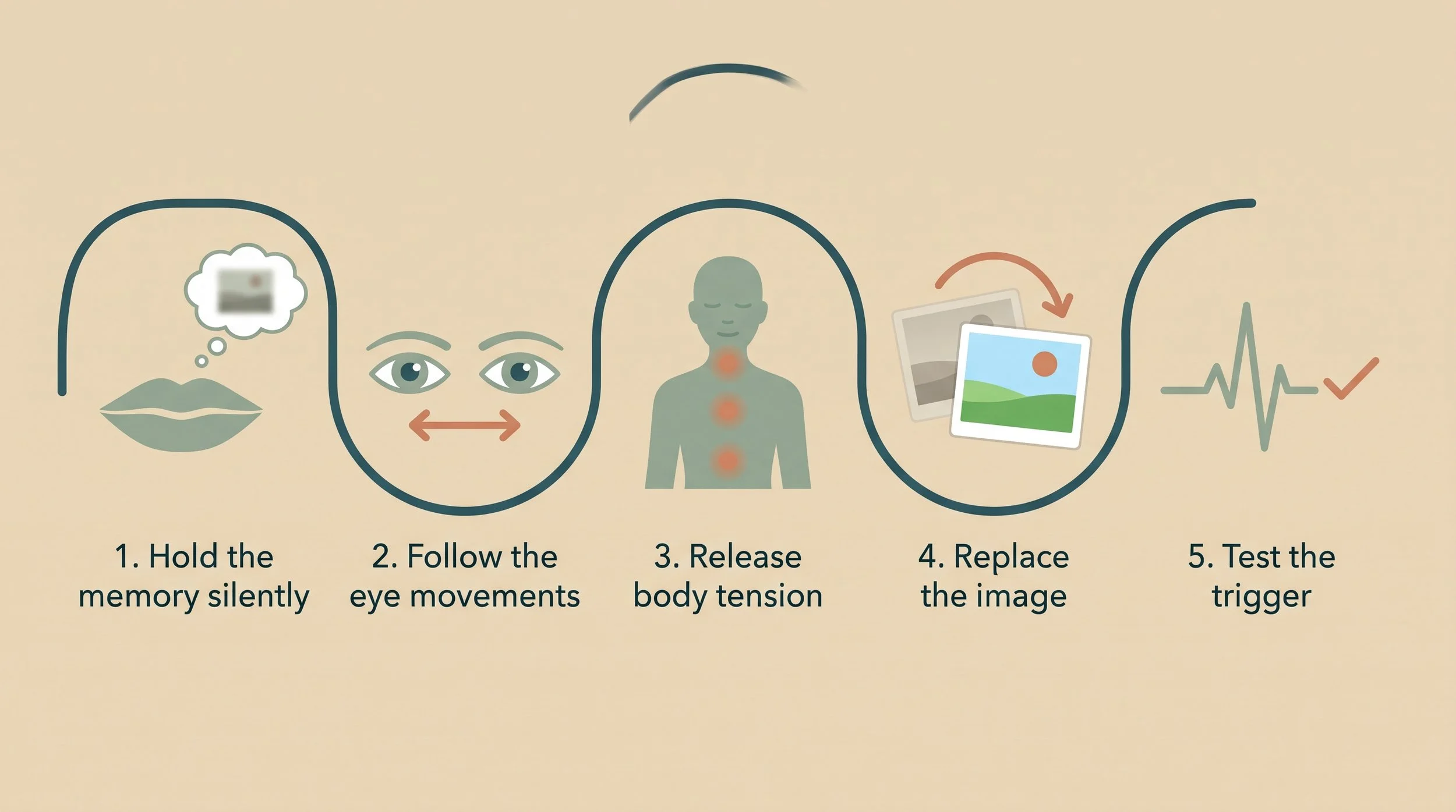
Many clients arrive at our Simpsonville clinic or join our virtual waiting room feeling uneasy about what lies ahead. That makes sense. To keep everything transparent and predictable, each appointment follows five clear steps:
Identifying the Target Memory (Without Talking Aloud): You bring the memory or phobia into focus in your own mind, keeping the details private.
Engaging Bilateral Eye Movements (Smooth Pursuit): You follow 30 to 40 smooth lateral passes across your line of sight to calm your nervous system.
Checking and Clearing Somatic Sensations: We pause to locate and release physical tension in your chest, throat, or gut before moving forward.
Rescripting the Scene Through Voluntary Image Replacement (VIR): You replace the distressed memory picture with a peaceful resolution that you pick yourself.
Testing Triggers Through Future Pacing and Body Checks: You imagine encountering the old trigger to make sure your body stays completely calm.
Tired of Talking About Your Past Without Feeling Better?
You do not have to spend another year rehashing your worst days. Explore Accelerated Resolution Therapy at VIVA Mind Therapy to discover how body-centered reprocessing brings rapid, measurable relief.
How Many Sessions of Accelerated Resolution Therapy Are Actually Needed?
While conventional counseling often runs for months without an end date, Accelerated Resolution Therapy resolves traumatic triggers in an average of 1 to 5 sessions.
Clinical trials published in peer-reviewed journals, including research on military veterans by Dr. Kevin Kip, show that ART produces major drops in PTSD and depression symptoms in an average of 3.7 to 4 sessions. In our Simpsonville clinic and across our South Carolina virtual sessions, over 85% of our clients notice a real shift in physical tension (an unclenching in the chest, quieted thoughts, or better sleep) within their first 2 or 3 appointments.
Treatment length depends on whether you are working through an isolated incident or long-standing developmental stress:
Single-Incident Trauma (1 to 3 Sessions): A car crash, an acute panic attack, a sudden medical event, a phobia, or a sudden loss often resolves in one to three appointments.
Complex Developmental Trauma (4 to 5+ Sessions): Childhood emotional neglect, relational betrayal, or ongoing attachment injuries are separated into specific sensory memories and processed in sequence so your nervous system never feels overwhelmed.
Accelerated Resolution Therapy vs. EMDR vs. Talk Therapy: Which Approach Is Right for You?
Looking at how ART, EMDR, and regular talk therapy operate under the hood helps you pick the right fit for your nervous system.
Many clients who reach out to VIVA Mind Therapy already know about EMDR or have spent years in traditional counseling. Both ART and EMDR use eye movements to unstick trauma, but the way sessions run day-to-day looks quite different:
| Clinical Dimension | Accelerated Resolution Therapy (ART) | Eye Movement Desensitization (EMDR) | Conventional Talk Therapy |
|---|---|---|---|
| Typical Treatment Arc | 1 to 5 sessions (rapid resolution) | 8 to 20+ sessions (medium-term) | Ongoing (months to years) |
| Verbal Storytelling | Not required (processing remains private) | Minimal to moderate verbal checking | Extensive (continuous verbal rehashing) |
| Eye Movement Cadence | Fixed sets (~30–40 smooth passes) | Variable, open-ended pass counts | None (purely verbal dialogue) |
| Primary Therapeutic Tool | Voluntary Image Replacement (VIR) | Free association & cognitive interweaves | Cognitive reframing & emotional venting |
| Somatic Intervention | Mandatory sensation check & release per set | Body scans across wider session phases | Often bypassed entirely |
| Telehealth Effectiveness | High (screen-calibrated eye sweeps) | High (virtual bilateral lights/audio) | High (conversational video) |
Talk therapy works from the top down, trying to use logic to calm an upset body. EMDR works from the bottom up, but allows your mind to free-associate wherever the thoughts wander, which can feel ungrounded.
ART takes a direct, focused path. It keeps you anchored on a single target, clears physical body sensations after each set, and closes the loop with Voluntary Image Replacement. You finish your appointment feeling settled and put together, not raw or overwhelmed.
Does Accelerated Resolution Therapy Work Over Telehealth in South Carolina?
Accelerated Resolution Therapy works remarkably well over secure video when led by a clinician skilled in virtual calibration and nervous system regulation.
Many people assume eye movements only work inside an office. Research and our ongoing work across South Carolina and North Carolina show that virtual ART delivers the same clinical results as in-person appointments.
Effective trauma work requires safety first. For many clients, processing difficult memories from their own favorite chair, wrapped in a blanket or with a dog resting at their feet, creates a sense of comfort that a clinical office simply cannot match.
The Virtual Eye-Tracking Protocol: Calibrating Screen Distance and Bilateral Flow
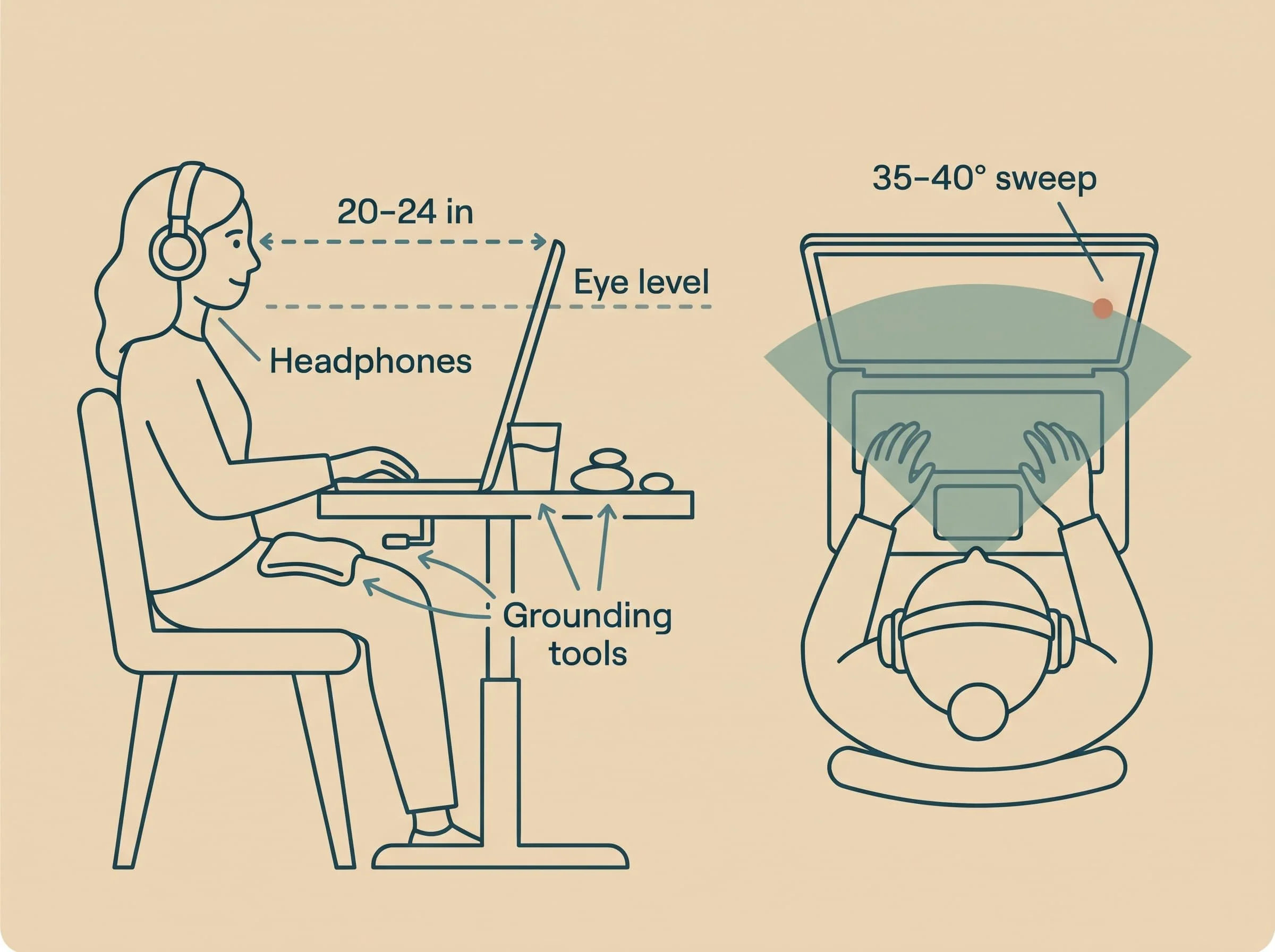
Running ART through a computer screen takes deliberate visual setup so your eyes track comfortably and your brain does the necessary processing:
Screen Positioning: Set your screen 20 to 24 inches from your face at eye level. Your eyes should sweep 35 to 40 degrees side to side without your head turning.
Calibrated Tracking Targets: Your clinician uses digital visual tools, such as moving optical light bars or smooth tracking markers, matched to your monitor size.
In-Home Co-Regulation: We agree on hand stop signals and simple physical grounding routines before touching any memory, keeping you in complete charge of the pace.
Bridging the South Carolina Care Gap: Telehealth Across Upstate, Midlands, and Lowcountry
Trained Accelerated Resolution Therapy providers are scarce across South Carolina. While our physical clinic sits at 205 Bryce Circle in Simpsonville (serving Greenville, Spartanburg, and Mauldin), we regularly hear from people across the state who cannot find a qualified clinician nearby.
Whether you live in the Lowcountry (Charleston, Mount Pleasant, Bluffton, Beaufort, Hilton Head), the Midlands (Columbia, Lexington), or across the state line in North Carolina (Charlotte, Raleigh, Asheville), virtual sessions bring specialized trauma care directly to you. You don’t have to spend hours driving up I-26 or I-85 just to get help.
Living in Charleston, Bluffton, Columbia, or Charlotte?
You can access specialized, rapid trauma resolution without leaving your home. Experience Virtual Trauma Reprocessing from Home: Connect with Stefany Pedroza and schedule your virtual intake today.
Frequently Asked Questions About ART Therapy in South Carolina
How many sessions of Accelerated Resolution Therapy do you need?
Most clients resolve a single traumatic event or phobia in 1 to 5 sessions, averaging 3 to 4 appointments. Complex trauma involving multiple childhood memories may require additional session clusters, but treatment remains focused and finite.
Can Accelerated Resolution Therapy be done effectively over telehealth?
Yes. Virtual ART utilizes clinician-guided visual tracking across a secure video screen, producing clinical outcomes equivalent to in-person office visits while allowing clients across South Carolina and North Carolina to process trauma in their own safe environment.
Do you have to talk about your trauma during an ART session?
No. ART does not require you to describe your traumatic memories out loud. You hold the scenes internally while following bilateral eye movements, allowing your brain to reprocess the imagery and release somatic tension without verbal storytelling.
Is Accelerated Resolution Therapy covered by insurance, or is it private pay?
VIVA Mind Therapy operates as a specialized private-pay practice to ensure total clinical autonomy, complete confidentiality, and freedom from insurance-mandated diagnostic restrictions. We provide detailed superbills that you can submit to your insurance provider for potential out-of-network reimbursement.
Ready to Process Your Past Without Retelling It? Start with VIVA Mind Therapy
You do not have to spend your days braced against old memories, waiting for your body to catch up with what your mind already understands.
Real healing is not about analyzing your pain for another year. It comes down to giving your nervous system the room to release old survival energy, rewrite stuck visual loops, and settle down.
At VIVA Mind Therapy, led by Stefany Pedroza, LISW-CP, we keep therapy focused, respectful, and grounded. Whether you visit our Simpsonville office or meet with us online from anywhere in South Carolina or North Carolina, our goal is simple: getting you back to feeling like yourself without wasting your time.
Getting started is straightforward, transparent, and completely pressure-free:
Schedule Your Free Consultation: Choose a convenient time for your confidential 15-minute phone consultation using our secure online scheduling portal. There are no extensive questionnaires, no intake tests, and zero obligation to share painful trauma details before you are ready.
Clarify Your Clinical Goals: Speak directly with Stefany Pedroza during our intake window (Monday–Friday, 9:00 AM – 3:00 PM) to discuss what you are experiencing, explore ART mechanics, and ensure this modality aligns with your nervous system needs.
Begin Accelerated Reprocessing: Meet in person at our 205 Bryce Circle office in Simpsonville or connect via secure, HIPAA-compliant telehealth to start clearing trauma in hours, not months.
Ready to Keep the Knowledge and Lose the Pain?
You deserve therapy that respects your time, your body, and your resilience. Break the Survival Loop: Schedule Your Free 15-Minute Consultation with Stefany Pedroza, LISW-CP today, or call our office directly at (864) 214-5811. We are here to walk alongside you.
About the Author & Practice
Stefany Pedroza, LISW-CP (also searched as “Stephanie Pedroza”), is the Founder and Lead Clinician of VIVA Mind Therapy, an outpatient trauma practice based at 205 Bryce Circle, Suite C, Simpsonville, SC 29681, serving clients in-person throughout Greenville County and statewide across South Carolina and North Carolina via secure telehealth.
As a bilingual (English/Spanish), first-generation clinical social worker and doctoral candidate with specialized post-graduate training in Somatic and Attachment-Focused EMDR, Accelerated Resolution Therapy (ART), and Internal Family Systems (IFS), Stefany brings years of clinical experience dedicated to a neuro-affirming, body-centered mission. She empowers adults, bicultural individuals, and trauma survivors to bypass months of passive talk therapy, unburden stored nervous system survival alarms, and achieve lasting physiological resolution.
Learn more about Stefany’s clinical philosophy, credentials, and specialized trauma formats on her full bio and clinical credentials page.
Medical & Clinical Disclaimer
The information presented in this article is published for educational and informational purposes only and does not constitute formal medical, psychiatric, or psychological advice, diagnosis, or treatment. Reading this article or interacting with VIVA Mind Therapy does not establish a therapist-client relationship. If you are experiencing a mental health emergency, severe psychological distress, or an acute medical crisis, please access immediate professional healthcare or emergency services.
Immediate Crisis Support Resources
If you are experiencing acute psychological distress, a mental health crisis, or thoughts of self-harm, please reach out immediately:
988 Suicide & Crisis Lifeline: Call or text 988 (Available 24/7, free, confidential nationwide).
Crisis Text Line: Text HOME to 741741 (Free, confidential 24/7 crisis support via SMS).
South Carolina Department of Mental Health (SCDMH) Mobile Crisis: Call 1-833-364-2274 (Available 24/7 statewide across South Carolina).
The Trevor Project: Call 1-866-488-7386 or text START to 678-678 (24/7 specialized crisis intervention for LGBTQ+ youth and adults).
Emergency Services: Call 911 or visit your nearest hospital emergency room if you or someone you know is in immediate physical danger.